The optical phenomenon called aventurescence creates sunstone's signature metallic glitters when flat mineral inclusions reflect light in coordinated patterns; scientifically speaking, it's copper or hematite platelets arranged in parallel alignment within feldspar that transform light into sparkle.
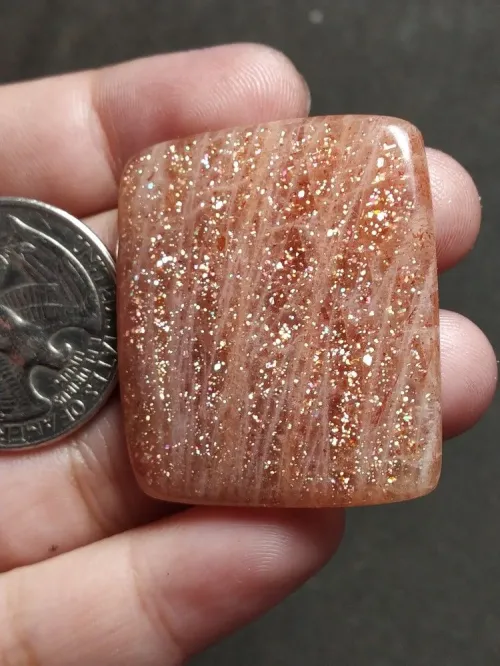
You've likely noticed sunstone catching the light in jewelry stores or mineral exhibits—that sudden burst of metallic flashes resembling powdered gold trapped in stone. Its name evokes solar imagery, yet the sparkle often puzzles observers who wonder how a seemingly opaque stone emanates such dynamic light. Gem enthusiasts compare it to other reflective stones, while geologists categorize it under feldspar variants. The disconnect emerges when market descriptions lean on poetic terms rather than explaining how aligned mineral platelets within its structure create this effect. Understanding its mechanics resolves why lighting angles dramatically change the glitter pattern, why some specimens appear fiery while others show bronze flashes, and why improper cutting can dim its signature display.
When discussing sunstone, people typically refer to its glitter called aventurescence—not a gem-specific term, but one scientifically describing any mineral's metallic flashes from reflective plate-like inclusions. This separates it from iridescence or labradorescence effects involving light diffraction. In practice, you observe aventurescence when moving the stone: glitters spark and extinguish rapidly as light angles shift across the mineral planes. Unlike surface-level shine, this happens internally, meaning the effect persists even if you scratch the surface slightly. Sunstone represents just one manifestation; geological sources reveal similar flashes in quartz or glass containing flaky minerals.
The intensity largely depends on how precisely these inclusions align internally. When hematite or copper platelets position in parallel, they reflect light simultaneously toward your eye, intensifying the sparkle. Microscopic misalignment may scatter reflections, softening the glitter effect. One pattern researchers note is that specimens formed slowly in stable volcanic environments tend to show better-organized structures. Additionally, the thickness and density of embedded platelets influence sparkle character—closely spaced microscopic plates create a finer shimmer resembling metal dust, while thicker, isolated plates produce distinct bright flashes during movement.
The mineral backbone responsible for sunstone belongs to feldspar, a common rock-forming silicate with interlocking crystal lattices. Specifically, most sunstone derives from oligoclase or andesine—feldspar variants rich in sodium and calcium. What transforms ordinary feldspar into sunstone emerges during crystallization: dissolved copper or iron enters the structure, later forming discrete microcrystals as the environment cools. Copper typically forms irregular flecks or bladed shapes, whereas iron oxide minerals like hematite develop hexagonal platelets that maximize light reflection when properly oriented.
From an optical perspective, a platelet's flat surface acts like a microscopic mirror. When thousands orient geometrically along a crystal plane, they collectively reflect light as you rotate the sample. Copper inclusions often create deeper red colors because they absorb shorter wavelengths while reflecting reddish light, simultaneously enhancing glitter through superior reflectivity. Geologists observe that growth interruptions during crystallization typically yield thicker, more reflective plates. Lab analysis confirms this alignment; X-ray diffraction measurements have revealed orderly planes of hematite crystals spaced between 10 to 100 micrometers apart—optimal for reflecting visible light while maintaining structural coherence within the host feldspar.
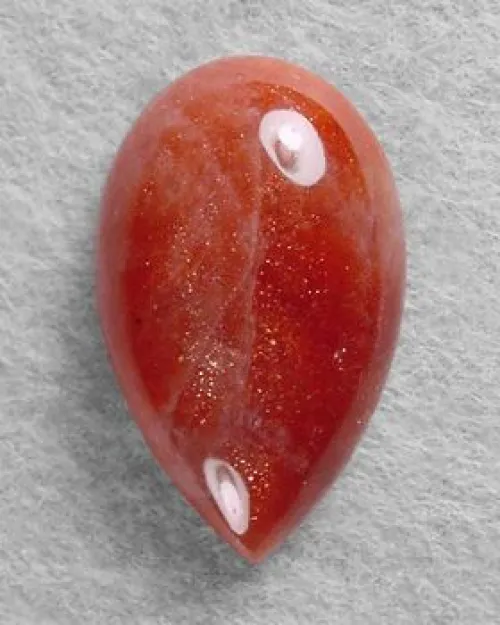
To understand sunstone’s glow, imagine shining light through it: copper particles catch photons and redirect them back, generating bright flares against the deeper-colored stone body. This aventurescent display varies significantly across specimens. You'll notice some appear predominantly orange with gold sparkles—characteristic of copper-rich varieties—while hematite-heavy versions show rosy reflections over a pinkish base. Transparency further modulates the effect; translucent stones create a luminous backdrop that enhances glitter visibility, whereas opaque bodies offer sharp metallic spots against a contrasting canvas.
Three variables dominate perception: plate orientation, light path clarity, and eye position. Rotate any sunstone under a lamp—you'll witness sparkles shifting directionality as previously reflective platelets drift out of optimal alignment relative to your pupils. Gem-cutters leverage this principle, carefully shaping stones so inclusions remain parallel to the dome of cabochon cuts, thereby maximizing collective reflection towards viewers. Surface polishing becomes crucial; rough textures scatter light away from reflective planes, diminishing flash intensity significantly. Even minor scratches that disrupt the top layer can partially obscure the underlying glitter by deflecting incident photons before they penetrate toward reflecting particles.
Sunstone primarily develops in cooling magma bodies, particularly volcanic flows like basalt or andesite where slow crystal growth allows inclusion nucleation. During formation, silica-rich feldspars crystallize first, forming frameworks while dissolved metals accumulate in concentrated pockets between crystals. When temperatures drop sufficiently below 700°C, metallic oxides precipitate out as defined structures. Crucially, undisturbed environments foster platelet alignment, whereas seismic activity during solidification promotes disorderly flakes that blunt optical displays.
In Oregon's basalt fields—a primary commercial source—volcanic events created slow-cooling lava environments where platy hematite layers organized meticulously within feldspar. Similar geological settings prevail in Norway's Tvedestrand deposits and India's Ramanathapuram districts. Researchers infer formation periods by examining adjacent mineral layers; slow-cooled sunstones show gradual crystal boundaries indicating months or years of stable solidification—conditions more likely to yield high-reflectance platelet alignment.
Sunstone’s durability—positioning between 6 and 7 Mohs—enables resilient jewelry applications such as rings and bracelets enduring daily wear. Historically, Viking navigators reportedly used Icelandic sunstones for polarization navigation—an application grounded in its light-filtering properties. Contemporary artisans primarily craft cabochons displaying vivid aventurescence with minimal faceting to preserve glitter continuity.
Its warm glitters associate symbolically with solar deities across cultures. Norse legends incorporated stones reflecting sunlight into ritual objects representing daylight renewal, while some Native American tribes attributed healing properties to copper-induced warm tones. Modern designers often highlight glitter density through simple bezel settings that maximize visible surface area, letting light interact dynamically with inclusions without metallic obstructions. While highly included pieces rarely achieve transparency, their reflective qualities remain prized assets for decorative artworks or inlays.
Your position relative to both sunstone and light sources alters sparkle perception significantly. Daylight typically gives brighter, whiter flashes whereas artificial lighting may intensify coppery tints. Faceted cutting attempts for sunstone often fail because beveled angles misalign platelets relative to expected viewing directions, scattering reflections instead of concentrating them like cabochons do.
Practical value assessments correlate glitter intensity with collector premiums. When examining pieces personally, look for even sparkle distribution under handheld light; clustered flashes may indicate suboptimal platelet placement. Cabochon forms remain predominant given their dome shape's compatibility with maintaining inclusion angles toward potential observers. Some users report heightened sparkle visibility when stones interact with moving light sources—perhaps explaining their popularity in dangling earrings versus static brooches.
Aventurescent sparkle remains distinct from interference-based optical phenomena like labradorescence or color-change Alexandrite. While those depend on layered microstructures refracting wavelength-specific light, aventurescence involves reflection off metallic solids—a simpler angular bounce. Material scientists note similar effects could theoretically occur in synthetic glass containing carefully aligned flakes. Lab replication remains challenging since controlling inclusion orientation demands extreme thermal precision.
Contemporary studies employ spectroscopy to quantify glitter density relative to platelet concentration, revealing logarithmic intensity relationships—low concentrations yield sporadic sparkles whereas higher densities create diffused luminosity. X-ray diffraction consistently confirms superior reflection where crystal lattice angles match inclusion alignment within one to five degrees. Such techniques offer non-destructive validation for specimens claiming natural origins since synthetic fakes struggle to replicate these intricate geometric relationships consistently.
If you want to observe sunstone like a materials scientist, start with lighting fundamentals. Place it under directional light—a desk lamp works—holding it around 40 centimeters away. Rotate the stone slowly; consistent sparkling across multiple angles indicates orderly inclusion layers, while sparse flashes suggest irregular alignments minimizing reflections. Notice whether the sparkles show copper-gold or reddish tones—this reveals metallic composition. Finally, assess glitter density versus stone transparency; moderate inclusions within translucent backgrounds typically maximize visual impact without darkening the body excessively. These observational steps bypass marketing narratives by focusing on verifiable optical mechanics.


$
