Oregon Sunstone is a naturally occurring copper-bearing feldspar mineral exclusively found within specific basalt flows in Oregon's high desert, distinguished by unique aventurescence – glittery internal reflections caused by microscopic metallic inclusions within the gemstone's crystalline structure.
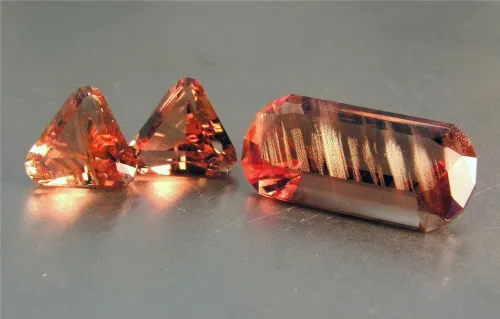
You might first notice Oregon Sunstone as an eye-catching piece of jewelry—perhaps a ring with fiery flashes or a pendant displaying an unusual hue ranging from light champagne to deep cherry red. Unlike many gems defined strictly by tradition or rarity, Oregon Sunstone catches attention because its visual properties stem directly from unique geological processes specific to a single American region. Scientific curiosity naturally arises: what causes those shimmering effects? Why does its color spectrum differ so dramatically? And what makes this stone geographically distinct? Understanding its mineral origin explains both its beauty and practical considerations for ownership.
Oregon Sunstone is scientifically classified as a variety of labradorite feldspar (plagioclase), differentiated by its discrete metallic copper inclusions rather than the typical iridescent play-of-color seen in standard labradorite. In practice, this means you'll observe distinct pinpoint flashes instead of sweeping color layers. Its designation as "Oregon" Sunstone isn't merely a marketing term but a geographical indicator; commercial deposits are economically minable only in specific locations in southeastern Oregon, formed under conditions not widely replicated elsewhere. From a mineralogical point of view, it shares its core chemical structure with common feldspars but gains its distinctive visual impacts from trapped elemental copper that crystallized during formation.
The fundamental structure arises from the plagioclase feldspar series (NaAlSi3O8 to CaAl2Si2O8), while copper inclusions ranging from nanoparticles to visible platelets create its optical signature. You can reliably distinguish it from non-copper-bearing feldspars through this internal metallic sheen visible under normal lighting conditions. Technical analysis reveals practical implications: a specific gravity between 2.68 and 2.72 places it comfortably within typical quartz-based gem ranges for mounting purposes, while its birefringent properties cause observable doubling of facet junctions under magnification – a useful identification tool for gemologists.
Its 6 to 6.5 Mohs hardness dictates protective settings in jewelry intended for everyday wear. This moderate durability means it can withstand daily contact better than softer gems like opal but tends to perform better in jewelry placements like earrings or pendants than in rings subjected to impact. Crucially, plagioclase feldspar possesses two distinct cleavage planes, creating structural vulnerabilities. One pattern observed is gem cutters meticulously orienting rough material before shaping to avoid cleavage directions, significantly reducing fracture risk during setting or wear. This orientation process impacts final stone shape and carat weight yield.
The observable color spectrum directly correlates with the copper content and particle size distribution within the crystal lattice. Clear, yellow, and pale pink stones generally contain sparse, minuscule copper nanoparticles diffusing visible light across wavelengths. Conversely, intense red hues indicate higher concentrations where copper platelets cluster densely enough to reflect a concentrated color signal. This relationship explains why deep red specimens are considerably rarer than lighter tones. The defining aventurescence (schiller effect) occurs when incident light reflects off these flat, parallel-oriented copper platelets. Schiller intensity typically intensifies with larger, well-aligned inclusion arrays visible as distinct flashes.
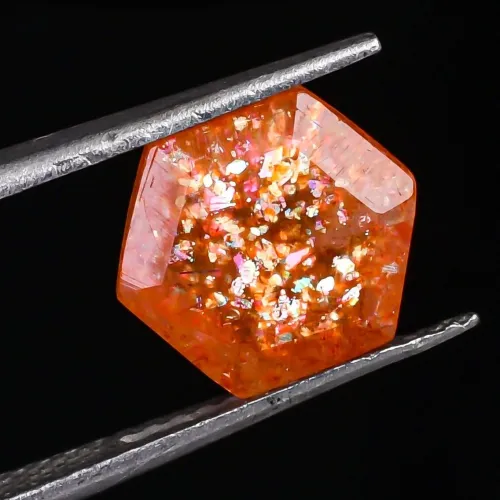
Samples can show bi-color zoning where copper distribution varies naturally within a single crystal, creating visually distinct copper-rich (often red/orange) and copper-poor (often colorless/green) sectors. One practical consequence is that faceted stones displaying balanced, visually integrated zoning patterns often command particular collector interest. The optical phenomenon remains stable; unlike some sensitive gems, the color doesn't fade noticeably under light exposure due to the elemental nature of the inclusions. While inclusions are the visual signature, exceptionally dense concentrations or irregular orientations can sometimes diminish transparency, influencing lapidary choices.
This gem forms exclusively within volcanic systems; it crystallizes directly from magma emplaced as thick lava flows during the Pleistocene epoch. Crucially, copper enrichment required specific oxidization conditions within these cooling basalts. Unlike many gemstones carried long distances by erosion, Oregon Sunstone remains primarily embedded within its original host rock matrix. Miners extract crystals directly from designated "sunstone beds" inside these ancient lava flows using careful site-specific procedures. This geological confinement explains why significant deposits have been verified only within a limited region of Oregon's high desert, primarily concentrated in Harney County.
Commercial mining mainly centers on two locations—the Spectrum Mine and the Ponderosa Mine—characterized by thick basalt flows favorable to larger, clearer crystals. Mining typically yields rough material ranging from fragments to crystals suitable for lapidary work, with many facet-grade pieces falling between 1 and 10 carats pre-cutting. Local geology impacts crystal characteristics significantly; crystals from different mines or even different beds within the same flow can show characteristic color tendencies or inclusion patterns identifiable via geochemical analysis.
Transparent and semi-transparent material is predominantly faceted using calibrated shapes like trilliant, oval, or round brilliant cuts to maximize light return through the gem body, enhancing the schiller effect visible internally. Cabochon cutting is frequently utilized for strongly included material displaying intense sheen, concentrating the aventurescence across a domed surface. From a material suitability standpoint, sterling silver represents a practical setting metal due to its durability and cost effectiveness, matching the gem's accessible price range relative to precious metals. In practice, simpler bezel or partial-bezel settings help protect the stone's facets and girdle region from knocks.
Market valuation correlates directly with several observable factors: vibrant, saturated color (especially red or saturated orange) often commands significantly higher pricing. Strong, well-distributed aventurescence visible under typical indoor lighting patterns positively impacts perceived quality and value. Gem clarity generally influences cost; eye-clean stones are less common than moderately included pieces in larger sizes. Bi-color or parti-color gems with aesthetically balanced zones can also achieve collector premiums. Crucially, transparent stones demonstrating distinct schiller effects tend to be valued over opaque materials lacking this signature feature.
Many people associate Oregon Sunstone distinctively with its state origin since 1987 official recognition, creating a strong regional identity different from broader global gem categories. While not traditionally designated as a month's primary birthstone, you might encounter references linking it to concepts like vitality or pioneering spirit, often reflecting narratives tied to its geographic origin in arid high desert landscapes. Its association with Oregon connects it to themes of natural heritage and regional geology; its modern emergence on the gem market during the late 20th century aligns with interests in locality-specific stones and transparently traceable ethical mining—practices increasingly emphasized today.
For cleaning accumulated dust, skin oils, or cosmetics residues, a practice involving lukewarm water, mild soap, and gentle wiping with a soft brush can maintain surface luster effectively. Avoid ultrasonic cleaners and steamers; while durable, vibrations and extreme heat can potentially propagate unseen cleavage fractures if sensitive areas exist within a particular stone. From a maintenance viewpoint, regular visual inspection of jewelry settings helps ensure claws haven't loosened over months or years of wear, especially critical given the potential vulnerability along cleavage directions if physical impacts occur. Proper storage when not worn means preventing surface contact with harder gems like sapphires and diamonds.
Wear patterns suggest Oregon Sunstone works well for pendants, earrings, tie pins, or brooches experiencing less direct physical exposure than rings. If used in rings intended for daily activities, choosing protective bezel settings with adequate rim height over prong settings lowers the risk of hard corner impacts chipping facet edges or girdle lines. Trilliant cuts or thick girdles may offer structural advantages. Remember that its 6–6.5 hardness means it can develop surface abrasions if rubbed against materials like quartz grit in daily environments like sand. Settings with solid lower galleries shield vulnerable pavilions.
Questions around ethical sourcing frequently involve traceability. Mines provide material typically through transparent direct channels or established dealers documenting origin confidently, unlike some globally traded gems with opaque supply chains. Scientific verification through geochemical fingerprinting methods remains feasible to establish geographic origin against established basalt signatures from Oregon deposits. A common point of interest involves "imperfections"—while some internal copper platelets create signature schiller, dense concentrations or irregular distributions can lead to lower lapidary yield. However, these natural characteristics also make each crystal distinct, and skilled cutting can optimize their display.
If you want to evaluate Oregon Sunstone systematically, look at several aspects consecutively. Notice the base color under diffused daylight first—stronger saturation often corresponds with higher copper presence and potential value. Next, view the stone under directed light, gently tilting it to observe the intensity and distribution of the schiller flashes; well-aligned internal platelets create distinct, vibrant reflections. Visually check for prominent natural inclusions that could impact durability or noticeable cleavage patterns near facet junctions indicating structural sensitivity. Finally, consider the cut's proportional precision: facets should be symmetric and polished, maximizing both brilliance and the visibility of the internal schiller effect without significant windowing. Focusing on these attributes offers more meaningful insights than generalized descriptions.
Q: Why is Oregon Sunstone significantly more expensive than regular sunstone?
A: Oregon Sunstone contains distinctive elemental copper platelets causing vibrant aventurescence and richer colors (especially bright reds/greens) in a mineralogical setting exclusive to Oregon. "Regular" commercial sunstone often refers to hematite-flake-containing oligoclase from global sources, appearing primarily orangish-red/brown-gold with less vivid phenomena. Geologic uniqueness and limited localized origin contribute to price differentiation.
Q: Can you expose Oregon Sunstone to water safely during swimming or bathing?
A: Occasional brief exposure like handwashing typically presents no issue. However, it's prudent to avoid prolonged submersion in harsh chlorinated or salt water, which may potentially accumulate within minor surface-reaching fissures or compromise adhesion under some bonded gem enhancements used on lower-grade material. Chemical interactions with copper inclusions and harsh cleaning agents remain possible over extended exposures.
Q: How does Oregon Sunstone compare to more established gems like ruby or sapphire for jewelry?
A: It offers a considerably softer option (6–6.5 Mohs vs 9 for corundum). This means settings must provide physical protection it wouldn't require for harder stones—especially ring designs. Its key appeal rests in its unique geological story, domestic American origin, signature schiller effect, intriguing color spectrum, and distinct optical properties like double refraction observable under magnification.
Q: Is all "Oregon Sunstone" naturally colored and included?
A: Natural material exhibits inherent color variations driven by copper concentration/distribution. Clear or lightly tinted yellow/green/orange stones occur naturally alongside deeper hues. Synthetic simulants exist, primarily sold as affordable fashion jewelry, but lack the geological formation signatures detectable by labs. Treatments like lattice diffusion for color enhancement are possible but uncommon; ethically sold material should disclose any interventions.


$
