Cleansing sunstone requires understanding its physical composition: Gentle methods like soapy water cleansing and avoiding harsh chemicals effectively maintain its aventurescent properties without damaging mineral inclusions.
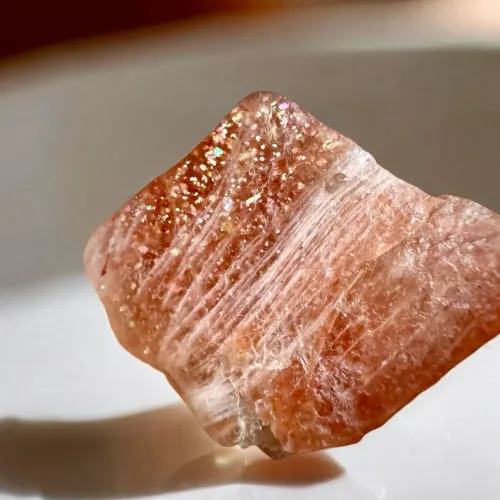
If you've recently acquired sunstone jewelry or a specimen, you might notice dust accumulation around its metallic inclusions after regular handling. Many mineral enthusiasts wonder about proper cleansing techniques when the crystal's characteristic sparkle appears diminished. These questions often arise from conflicting advice online – spiritual cleansing versus material preservation – leading to confusion about safe physical maintenance. Sunstone's optical properties are particularly vulnerable to inappropriate cleaning methods due to plate-like hematite or goethite crystals embedded within its feldspar structure. This guide examines evidence-based principles for maintaining sunstone integrity, focusing on verifiable material characteristics rather than metaphysical claims.
Different crystal types demand varying cleansing approaches based on their mineral properties. In practice, the primary question for sunstone becomes: Which methods achieve cleanliness without compromising aventurescent effects created by its platelets? Common solutions used for quartz-based crystals often prove problematic here due to fundamental structural differences. From a material perspective, feldspar minerals like sunstone typically exhibit greater cleavage planes and internal vulnerabilities compared to single-crystal structures, creating distinct limitations for maintenance routines.
Technical examination shows that sunstone's primary cleansing constraint originates from metal oxide inclusions. These platelets can detach during aggressive cleaning due to differing density and bonding characteristics. Gentle surface washing with lukewarm soapy water remains the safest approach in most everyday situations, using neutral pH detergents to prevent microscopic etching. Unlike more durable gems, sunstone's cleaning frequency should be determined by visible residue around inclusions rather than predetermined schedules. The porous nature around these internal structures may retain chemical residues over time, particularly with frequent cosmetic contact.
Knowing sunstone's internal architecture explains why certain cleansing techniques present risks. At magnification levels, one observes flattened mineral suspensions randomly oriented within orthoclase or oligoclase feldspar. These structural characteristics directly impact maintenance decisions for several clear reasons. Firstly, mechanical separation between the host crystal and its inclusions creates microscopic cavities where cleaning agents might accumulate. Secondly, the metallic platelets themselves possess different reactivity profiles, especially toward chemical agents.
Analysis confirms these platelets consist predominantly of hematite (Fe₂O₃) or goethite (FeO(OH)), responsible for the glittering effect under light. When subjected to vigorous physical action, these mineral components may experience fracturing through their thinnest dimensions. In materials science terms, the bonding forces between feldspar and platelets are weaker than atomic bonds within homogenous crystals. Consequently, sonic vibration devices typically employed for jewelry cleansing could potentially dislodge these embedded particles through resonance frequency mismatches. Gentle manual techniques preserve these interfaces better than automated processes.
Sunstone's distinct visual signature heavily influences cleansing outcomes, particularly light reflection and transmission properties. Upon initial examination, the crystal displays color variations from pale orange to reddish-brown with metallic reflections shifting with viewing angles. These optical behaviors primarily result from suspended platelets reflecting and refracting light. When surface debris accumulates around inclusions, it often diminishes this aventurescent quality first – a practical indicator that cleaning maintenance is needed.
The interaction between light scattering and platelet integrity necessitates careful handling. Hardness testing reveals sunstone at 6-6.5 Mohs, placing it below common quartz countertops or dust particles, increasing abrasion vulnerability during cleaning. Transparency ranges from translucent to opaque depending on platelet density, affecting how deeply stains might penetrate. One observed pattern shows higher density inclusions correlate with greater surface shadowing, sometimes obscuring accumulated residues. When polishing the surface, avoid rotary tools with compounds since microscopic platelets can align differently during wear, gradually changing the stone's appearance.
Sunstone originates through geological processes combining specific environmental chemistry with volcanic activity. Major deposits occur in volcanic rocks where mineral-rich fluids deposited copper or iron oxides during cooling events, creating Oregon specimens with high optical clarity versus Norwegian stones exhibiting denser inclusions. These natural origin factors subtly influence maintenance requirements through inclusion size distribution and adhesion strength variations across geographical sources.
The formation history explains why cleansing standardization remains challenging; Oregon sunstones often contain copper inclusions instead of iron oxides, potentially altering reactivity towards chemical agents. Materials from sedimentary deposits such as India's Tamil Nadu region demonstrate different inclusion patterns formed through secondary enrichment processes. Temperature fluctuations during crystal growth may cause inclusion adhesion variations seen under scanning electron microscopy. Consequently, stones sourced from different regions may respond differently to identical cleaning solutions, making visual assessment more reliable than universal protocols.
Implementing evidence-based sunstone maintenance involves balancing effectiveness against material vulnerabilities through structured approaches. Start with establishing cleaning frequency based on interaction environments: Daily-worn jewelry in dusty conditions requires different attention from display specimens. One verified pattern indicates that using cotton swabs dipped in 1:10 detergent solutions reaches inclusion edges effectively. Always dry immediately with microfiber cloths since prolonged moisture exposure could potentially affect mineral boundaries.
Storage ConsiderationsPost-cleaning protection significantly impacts long-term preservation. Keep sunstone separated from diamonds and corundum which can easily scratch its surface. Environmentally controlled storage mitigates potential changes; relative humidity above 65% combined with thermal cycling might gradually shift inclusion positions in some specimens.
Special Handling ScenariosCosmetic products create specific cleaning challenges due to their diverse chemical formulations. Lipstick pigments and silicone-based foundations can become trapped around internal platelets. In such cases, isopropyl alcohol applied locally through cotton swabs may safely dissolve residues without submersion. Always perform localized spot testing first since mineralogical variations exist between stones.
Beyond physical maintenance, sunstone features in cultural contexts such as birthstone applications and historical ornamentation. These associations sometimes lead to unverified cleansing rituals that risk physical damage. Objectively evaluating crystal condition requires separating metaphorical interpretations from mineral preservation principles. Aventurescent intensity determines collector or market valuation in measurable ways independent of metaphysical interpretations.
Long-term care documentation suggests periodic professional inspection helps identify microscopic fissures before they become visible integrity concerns. When evaluating value changes, focus on optical characteristics: Metallic reflection area, platelet distribution uniformity, and surface clarity maintenance. Preservation efforts should prioritize stabilizing environmental humidity around 40-50% to slow potential inclusion boundary migration. Conservators typically measure light scattering consistency rather than spiritual attributes for condition reporting, ensuring preservation techniques remain grounded in material stability.
Approach sunstone maintenance with fundamental principles to maximize preservation without unnecessary complication. First, always assess inclusion conditions before cleaning – use magnification to inspect for loose platelets. Second, choose cleaning agents by chemical reactivity rather than tradition; pH-neutral solutions generally create minimal risk. Third, differentiate between surface cleaning for aesthetic purposes versus preserving structural integrity when considering value-related care. Implementing these material-based considerations helps avoid irreversible damage during maintenance routines.
Can sunlight exposure cleanse or recharge sunstone crystals?
Extended ultraviolet exposure shows no measurable benefits for physical properties and may cause thermal stress cracking in dark specimens.
What household chemicals create irreversible sunstone damage?
Acidic solutions and abrasive cleaners may cause irreversible surface etching around inclusions through preferential mineral dissolution.
Is warm saltwater immersion safe?
Saline solutions risk chloride ion infiltration along microscopic fractures, potentially causing long-term structural weakening.
How does steam cleaning affect sunstone?
Rapid thermal changes during steaming can fracture inclusions and are generally discouraged regardless of duration.


$
