Sunstone is a distinct feldspar mineral prized for its aventurescent glow and moderate durability, offering both functional properties for jewelry-making and culturally valued aesthetic qualities observed across different contexts.
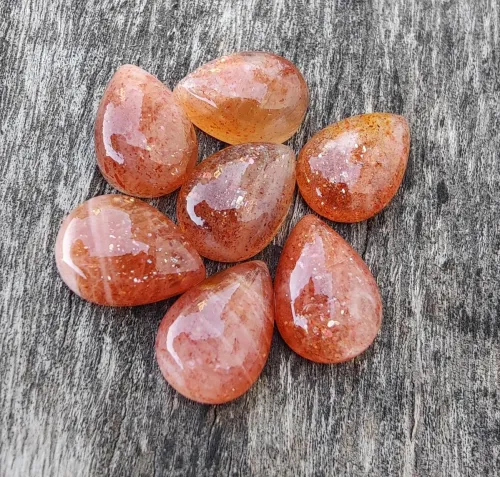
You might first encounter sunstone while browsing jewelry collections or mineral exhibits, where its distinctive amber hues and metallic glimmers spark immediate curiosity. For mineral enthusiasts, it presents a fascinating study in light interactions with geological structures. Jewelry designers often select it for its warm color palette and unique optical properties, while others recognize it from cultural narratives associating it with solar symbolism. This convergence of practical and perceptual qualities naturally invites further exploration into what sunstone offers beyond its surface appeal.
When examining sunstone's defining characteristics, you'll immediately notice its signature aventurescence—a sparkling phenomenon created when light strikes metallic particles within the stone. In practice, these reflections shift position as you rotate the stone, generating dynamic flashes against a warm-toned background. This luminosity explains why early observers named it after sunbeams.
From a materials perspective, the inclusions creating this effect typically consist of microscopic copper platelets, though hematite may also contribute. Light interacts with their flat surfaces according to predictable optical principles: angle-dependent reflections generate intense sparkles in bright environments while appearing more subdued in softer lighting, meaning the visibility of the effect can vary with ambient conditions.
With specific gravity typically ranging from 2.62 to 2.65, sunstone demonstrates density comparable to other feldspar minerals, while its moderate toughness makes it usable in jewelry. However, the cleavage planes require careful cutting orientations to maintain stone integrity. Long-term usage observations suggest minimal structural changes occur when pieces avoid sustained contact with harder minerals.
Understanding sunstone begins with its fundamental identity as a plagioclase feldspar. This classification distinguishes it from lookalike materials, with accurate identification often requiring examination beyond casual observation.
The mineral's structure includes silicon-oxygen tetrahedrons arranged with gaps that permit copper ion integration during formation, a process occurring within syenitic rock environments. The crystallization patterns typically show monoclinic symmetry, with thin sections under magnification revealing intergrown crystals. This composition produces two-directional cleavage planes—a crystallographic property requiring consideration during cutting procedures to avoid fractures.
Sunstone's most noted characteristic manifests when you rotate it under direct light: a dynamic "schiller" effect produced by light hitting crystalline inclusions. This aventurescence appears as scattered metallic flashes that change intensity with viewing angles.
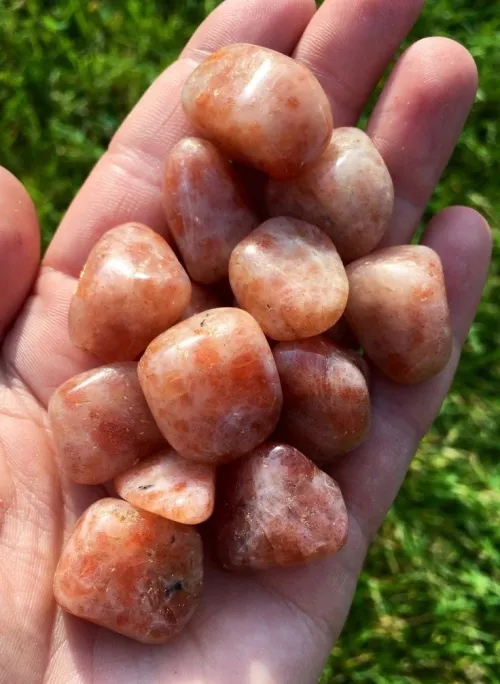
Analysis shows that copper-inclusion sunstones create distinct reddish sparkles compared to mica-generated effects, with the visibility of this trait depending on inclusion density and cut orientation. Standard body colors range from pale champagne tones to deeper coppery browns, while thinner specimens often show brighter reflections due to light traveling through shallower material. When assessing stones professionally, one common pattern involves evaluating optical uniformity – the distribution consistency of these sparkles – which impacts perceived quality.
Sunstone development typically occurs in volcanic basalt flows where specific environmental conditions enable copper crystallization within feldspar structures. You'll find the highest concentrations where historic lava movements interacted with copper-rich solutions.
Geographical distribution centers around mineralogically favorable regions, including Norway's Precambrian bedrock deposits, North America's Oregon deposits containing coppery sunstone varieties, and volcanic zones in Southern India. Mining these areas presents particular challenges as sunstone occurs in isolated formations, contributing to supply variability that may influence regional market availability. In some cases, concentrated mining operations in Oregon have established standardized dimensional grades accommodating commercial jewelry settings.
When jewelers evaluate sunstone, the key focus remains optimizing the aventurescent display through specific cutting techniques that enhance light interactions. Cabochon shaping dominates as it naturally showcases reflections without the fracture complications that may occur in faceted pieces.
Value assessment depends heavily on the saturation of the base hue and sparkle distribution. Jewelry designers prioritize balanced sparkle dispersion rather than sheer inclusion density, as excessive coverage can diminish the interplay between colorful background and reflections. Protective bezel settings frequently complement sunstone pieces, providing structural support against impacts that might exploit cleavage planes. Material sourcing costs tend to reflect geological scarcity and extraction complexities in remote regions.
Historically, sunstone's luminosity led multiple cultures to associate it with solar deities or vitality symbolism, though such interpretations vary regionally. Scientific methods indicate these meanings stem not from any measurable properties but from psychological pattern-matching where luminosity sparks metaphorical connections across societies.
Current perceptions frequently reference warmth and openness archetypes, observable in its description and usage within artistic contexts. Such associations remain culture-dependent: Scandinavian traditions historically valued sunstone's appearance differently than Native American creators who incorporated Oregon sunstone into artifacts. Research indicates these meanings continue evolving with no universal attribution, reflecting localized traditions.
When selecting sunstone for practical usage, its moderate hardness requires designs that minimize abrasion exposure. Regular cleaning typically involves soap solutions and soft brushes to maintain surface integrity without disrupting inclusion stability.
Environmental factors like extended intense heat should be considered as high temperatures may cause discoloration in specific varieties. Storage approaches that avoid continuous pressure against harder minerals help preserve optical qualities. Light exposure shows minimal long-term impacts in standard conditions, allowing display without significant degradation concerns.
If you want to assess sunstone systematically during purchases or examination, begin by determining three reliable indicators: First, verify the distinct metallic sparkles that reposition with stone movement. Next, note characteristic warm body tones ranging from light yellows to reddish-browns. Finally, check settings for protective elements that accommodate moderate wearability. These features represent tangible properties observable without specialized tools. For long-term preservation, periodic gentle cleaning following standard procedures may benefit the piece.


$
